
Global Venture Capital Half-Time Report: H1 2026
The first half of 2026 has been a period in which capital concentration in global venture capital reached an unprecedented intensity, artificial intelligence solidified its position as the undisputed axis of the technology economy, and the scale of individual funding rounds moved into territory that would have been unthinkable only a few years ago. In an environment where investor appetite remained highly selective and increasingly directed toward a small number of category-defining companies, global venture capital nonetheless posted one of its strongest first-half performances of the decade — a result that, on the surface, looks like broad-based strength but on closer inspection reveals a market being reshaped around a handful of foundational AI labs.
Global startups raised more than $500 billion in venture capital in H1 2026 alone, a figure that places the first half of the year on pace to challenge the record levels last seen in 2021. Yet this headline number tells only part of the story. When the three largest foundational AI labs - OpenAI, Anthropic, and xAI - are excluded from the total, the underlying market still grew, but at a markedly more modest pace, underlining just how much of this year's growth is being driven by a narrow set of frontier AI players raising capital at a scale with no historical precedent.
This report examines the first half of 2026 across four axes: overall investment volume and the rise of the mega-round, geographic shifts in where capital is flowing, the dominance of artificial intelligence within the sector mix, and emerging thematic areas such as defence tech, climate tech, and wildfire management technology. All quantitative data and graphs used in this analysis is drawn from Dealroom's “The Half-Time Report - H1 2026 Venture Update”, published on 29 July 2026.
I. General Outlook and Market Dynamics
Investment Volume
Global venture capital investment surpassed $500 billion in the first half of 2026, with actual and projected figures for the full year converging around $506 billion on an H1 run-rate basis. This places 2026 as the second-strongest year for global VC since records began, trailing only the exceptional peak of 2021 ($693 billion) and comfortably ahead of every year in between, including 2022 ($490 billion), 2023 ($324 billion), 2024 ($352 billion), and 2025 ($444 billion). After four consecutive years of either contraction or modest recovery, H1 2026 marks a genuine re-acceleration of global venture funding.
Global VC Investment, 2019–2026

However, the composition of this growth is at least as important as its scale. A significant share of the increase is attributable to a small number of extraordinarily large rounds raised by frontier AI labs. When OpenAI, Anthropic, and xAI are removed from the dataset, global VC investment for 2026 falls to a projected $269 billion; still a healthy, growing figure relative to recent years, but roughly half of the headline total. This confirms that while the broader venture market is genuinely expanding, the AI supercycle led by a handful of foundational model companies is doing much of the heavy lifting at the top of the funnel.
Global VC Investment – Excluding OpenAI, Anthropic and xAI, 2019–2026

The first half of 2026 redefined what a large venture round looks like. OpenAI closed a $122 billion round in March 2026 to accelerate the next phase of AI development — a transaction size with no precedent in venture capital history. Anthropic followed with a $65 billion Series H in May 2026 at a $965 billion post-money valuation, having already raised $30 billion in a Series G in February 2026 at a $380 billion valuation. Elon Musk's xAI raised $20 billion in January 2026, with participation from investors including Nvidia, Cisco, and Fidelity.
Beyond the three largest foundational model labs, other standout rounds in the first half of the year included a $16 billion late-stage round for an autonomous driving company, a $12 billion growth-equity round for a physical AI lab, a $10 billion late-stage round for a space rockets company, a $7.4 billion early-VC round for an open-source foundational model company, and a $5 billion Series H for a defence-focused autonomous systems company. Taken together, these nine rounds illustrate where the very top of the market is concentrated: foundational AI models, physical AI and robotics, autonomous systems, defence, and space.
The Biggest Global Venture Capital Rounds in 2026

$2 Billion+ Mega-Rounds
The scale of individual rounds is also visible in aggregate. Globally, the number of $2 billion-or-larger “scale-up rounds” has grown sharply over the past decade. From 2015 through 2024, these mega-rounds remained relatively uncommon, generally ranging from just 2 to 10 transactions per year and often appearing as isolated spikes rather than a sustained trend. That pattern changed decisively in 2025, when the number of $2B+ rounds jumped to 17, followed by a further increase to 21 in 2026. In other words, the market has already recorded more mega-rounds in 2026 than in any prior year shown in the series.
Global $2B+ Rounds

This acceleration is significant not only because of the absolute number of deals, but also because it signals a broader shift in the structure of venture financing. Rounds of this magnitude were once exceptional events, typically associated with a small number of highly mature, category-defining companies. Today, they are becoming a more established feature of the global funding landscape. The nearly threefold increase in $2B+ rounds between 2024 and 2026 suggests that capital is increasingly concentrating around companies perceived to have the potential to scale rapidly and command very large valuations. Rather than representing a handful of one-off outliers, mega-rounds are increasingly becoming a structural component of the current venture cycle.
II. Geography
Country Rankings
The United States remains, by a wide margin, the dominant force in global venture capital. With $382.1 billion raised so far in 2026, the US has attracted more than eight times the amount of capital raised by second-placed China ($43.9 billion). This gap highlights the continued concentration of venture capital at the very top of the global market, particularly around large-scale technology and AI companies capable of attracting exceptionally large rounds. The United Kingdom ranks third globally with $17.1 billion, followed by India ($7.58 billion) and Germany ($5.46 billion).
Germany's move into fifth place is particularly notable. The country has strengthened its position among the world's largest venture markets, reflecting a broader recovery and expansion of European venture activity. Germany is now ahead of several traditionally important startup ecosystems, underlining the increasing ability of European markets to attract larger pools of venture capital despite the continued dominance of the US.
Another notable development is Sweden's entry into the global top 10. With $2.78 billion raised so far in 2026, Sweden ranks tenth, effectively tied with Israel at ninth ($2.80 billion). The emergence of Sweden alongside Germany reinforces the importance of European ecosystems in the current funding cycle. While the US continues to capture the majority of global capital, the geographic picture below the top two markets is becoming more competitive, with several European ecosystems gaining ground.
2026 rankings point to a two-speed global venture market: an exceptionally concentrated top end dominated by the US and China, alongside a broader group of established and emerging ecosystems competing for an increasing share of global capital. Germany's rise and Sweden's entry into the top 10 are therefore more than ranking changes; they indicate that the European venture landscape is becoming increasingly significant in absolute funding terms.
Growth Leaders Among Established Markets
The picture becomes even more interesting when looking at growth rather than absolute funding volumes. Among countries with at least $1 billion in VC funding, the United States posted by far the highest projected growth rate for 2026, at 206.7%. This exceptional increase reflects the concentration of some of the year's largest AI mega-rounds in the US and demonstrates how a small number of very large transactions can materially reshape national funding totals. It also reinforces the structural advantage of the US ecosystem in supporting companies at the scale required to raise multi-billion-dollar rounds.
Singapore, with 106% growth, and Australia, at 71%, also recorded particularly strong increases, showing that the acceleration in venture activity is not limited to the world's two largest funding markets. China grew by 67.7% to reach $54.7 billion, further consolidating its position as the world's second-largest venture ecosystem. These markets combine substantial existing venture infrastructure with strong momentum, making them important contributors to the overall recovery in global funding.
Top Countries for VC Funding Growth in 2026

Among the more established European markets, Germany (+46.7%), Sweden (+31.5%), and the United Kingdom (+31.3%) all recorded solid double-digit growth. The performance of Germany is especially significant when viewed alongside its rise to fifth place globally: the country is not only attracting more capital in absolute terms, but is also growing faster than many of its established peers. Sweden's double-digit growth similarly helps explain its move into the global top 10.
At the other end of the spectrum, Switzerland (-0.6%), Canada (-0.8%), and Israel (-10.2%) were the only major markets to contract year-on-year. This divergence suggests that the recovery in global venture capital is not being distributed evenly across established ecosystems. Instead, capital is increasingly flowing toward markets where AI, deep tech, and other high-growth sectors are generating opportunities for large-scale investment.
Taken together, the data suggests that 2026 is not simply a year of broad-based recovery. It is also a year of changing competitive dynamics between venture ecosystems, with countries that are particularly exposed to AI and other capital-intensive technology sectors benefiting disproportionately from the current funding environment.
Fastest-Growing Ecosystems Worldwide
Looking beyond the largest and most established venture markets reveals an even broader acceleration in global startup funding. When countries are ranked by year-on-year growth rather than total funding, Uzbekistan stands out as the fastest-growing venture ecosystem, with funding up 544.5%. It is followed by Austria (+307.7%), Ghana (+278.3%), and Pakistan (+264.2%). These growth rates are substantially higher than those recorded by most of the world's largest venture markets, illustrating how rapidly smaller ecosystems can expand from a relatively low funding base.
The list also includes a diverse group of markets spanning different regions and stages of ecosystem development. China appears among the fastest-growing ecosystems at +231.4%, while Argentina (+229.0%), Ukraine (+209.5%), Kenya (+200.2%), Hungary (+185.3%), and Croatia (+181.4%) also recorded very strong year-on-year increases. The geographical diversity of this group is notable: the acceleration is not confined to North America, Western Europe, or the traditional technology hubs of Asia.
At the same time, these growth figures should be interpreted differently from the absolute funding rankings. For smaller ecosystems, very high percentage growth can be generated by a relatively limited number of transactions or by expansion from a comparatively small starting base. Nevertheless, the direction of travel is important. The emergence of countries such as Uzbekistan, Ghana, Pakistan, Kenya, and Croatia among the fastest-growing markets indicates that venture capital activity is reaching a wider range of geographies.
This creates a more nuanced picture of the global venture market in 2026. The largest pools of capital remain highly concentrated in a handful of countries, particularly the US and China, while a second group of established ecosystems such as Germany, Sweden, the UK, Singapore, and Australia is gaining momentum. At the same time, frontier and emerging ecosystems are recording some of the fastest rates of expansion. In other words, the global venture market is becoming both more concentrated at the very top and more geographically expansive underneath it.
The combination of these trends suggests that the current venture cycle is not simply a return to pre-2022 funding patterns. Capital is increasingly being deployed at very large scale in leading ecosystems, while venture activity is simultaneously spreading into markets that previously accounted for a much smaller share of global funding. This widening geographic footprint is an important feature of the 2026 venture landscape and provides context for the rapid changes visible in the global country rankings.
III. Artificial Intelligence
AI Accounts for the Majority of Global Venture Capital
Artificial intelligence has moved decisively from being one of the fastest-growing segments of venture capital to becoming the defining theme of the global market. AI startups raised $398 billion in H1 2026, representing roughly 77% of all global venture capital deployed during the period. This marks a decisive threshold: more than three-quarters of all venture funding globally is now flowing into companies classified as AI-related.
The scale of this shift becomes even clearer when viewed over a longer time horizon. AI accounted for $198 billion of global venture investment in 2025, already representing almost half of total VC investment. In H1 2026, however, the share has risen to 77%, indicating that the acceleration has continued at an extraordinary pace. This means that AI is no longer simply attracting a disproportionate amount of new capital; it is increasingly shaping the overall structure and direction of the venture market.
Global VC Investment, AI and non – Rest (2012–2026)

A key driver of this transformation is the emergence of very large late-stage financing rounds around companies developing foundational AI models and infrastructure. As the cost and complexity of training and deploying frontier models has increased, capital requirements have risen accordingly. This has pushed a growing share of venture investment toward a relatively small number of companies capable of operating at exceptional scale. The result is a market in which a handful of very large AI transactions can have a meaningful impact on global venture totals.
This concentration also helps explain the connection between the rise of AI and the broader emergence of $2B+ mega-rounds. AI companies are increasingly operating in capital-intensive areas where computing infrastructure, model development, data, chips, and deployment require substantially more funding than the typical software startup model. As a result, the growth of AI is not only changing which sectors receive capital; it is also changing the size and structure of venture financing itself.
The implications extend beyond individual AI startups. Dealroom's data suggests that large late-stage rounds, infrastructure build-out, and foundational models are now central components of global capital allocation. In practical terms, this means that the current venture cycle is increasingly being shaped by investors' expectations around AI's ability to generate very large markets and support companies at unprecedented scale.
At the same time, the 77% figure should not be interpreted as meaning that non-AI sectors have disappeared from the venture landscape. Rather, it illustrates the extraordinary relative weight that AI has acquired. Other sectors continue to attract capital, but they are increasingly competing for attention and funding against an AI investment cycle of exceptional size. The defining feature of H1 2026 is therefore not simply that AI is growing rapidly, but that AI has become the central organizing force of global venture capital.
A Regionally Uneven Picture
While AI's dominance is a global phenomenon, its intensity varies sharply across regions. The United States is the clearest outlier: AI now accounts for 86% of all venture capital raised in the country. Globally, the share stands at 77%, compared with 63.8% in China and 54.4% in Europe. The differences are substantial and reveal that the AI investment boom is not being experienced uniformly across the world's major venture ecosystems.
The US position reflects the country's unique concentration of frontier AI companies, hyperscalers, deep technology investors, and highly developed capital markets. The presence of the largest foundational model labs creates an ecosystem in which enormous amounts of capital can be deployed into a relatively small number of companies and infrastructure providers. Dealroom explicitly identifies scale, speed, and capital depth as key factors behind the US lead.
This concentration creates a reinforcing cycle. The presence of leading AI companies attracts significant amounts of venture and growth capital, while the availability of capital enables those companies to pursue increasingly ambitious research, infrastructure, and commercialization strategies. In turn, the scale of these companies and their financing rounds strengthens the position of the surrounding ecosystem. The result is a particularly high share of total US venture capital being absorbed by AI-related companies.
AI as % of Total VC Investment

China presents a somewhat different picture. At 63.8%, AI still represents a clear majority of venture investment, but its share is meaningfully below the US level. This suggests that China's venture market, while strongly exposed to AI, retains a somewhat broader distribution of capital across other sectors. At the same time, China's significant overall funding growth means that the lower percentage share should not be interpreted as a lack of momentum in AI; rather, it reflects the relative size of investment going into non-AI areas as well.
Europe sits further down the spectrum, with AI accounting for 54.4% of venture capital. This still represents a majority of European VC investment and confirms that AI has become a central investment theme across the continent. However, the lower share indicates a more diversified venture capital base compared with the US. European capital continues to be distributed across a broader range of sectors, even as AI investment accelerates.
The regional gap therefore highlights an important distinction between AI intensity and AI momentum. The US has both the highest concentration and the deepest pool of capital directed toward AI. Europe, by comparison, is ramping up from a more diversified starting point. Dealroom attributes Europe's increasing AI activity to catch-up investment, sovereign support, and broader adoption of AI across industries. This suggests that the European opportunity is not necessarily about replicating the exact US model, but about building capabilities and investment depth across a wider industrial base.
The data also illustrates how the geography of venture capital increasingly matters for understanding the AI economy. Where the leading AI companies, hyperscalers, research capabilities, and capital markets are concentrated, a disproportionately large share of venture capital is likely to follow. Regions without the same concentration may still experience rapid AI investment growth, but their venture markets are likely to remain more diversified.
The regional picture points to a widening gap in the scale and concentration of AI investment, even as AI becomes a dominant theme everywhere. The US currently occupies the most concentrated position, while China and Europe are also allocating the majority of their venture capital to AI but retain a broader sectoral mix. This divergence will be an important factor in determining which ecosystems are able to produce and finance the next generation of frontier AI companies.
IV. Sector Trends
AI, Deep Tech, and Enterprise Software Lead
At the sector level, Artificial Intelligence ($429.9 billion in 2026), Deep Tech ($413.5 billion), and Enterprise Software ($330 billion) clearly lead the global venture funding landscape. The scale of these three categories is substantially ahead of the next group, with Robotics receiving $66.7 billion and Health $44.1 billion. Transportation ($38.8 billion), Fintech ($26.7 billion), Semiconductors ($24.1 billion), Energy ($23.2 billion), and Space ($21.3 billion) complete the leading sectors. The gap between the top three and the rest of the market highlights how strongly current venture capital is concentrated around AI-enabled software and capital-intensive deep-tech opportunities.
The composition of funding is also changing compared with the recent historical period. Several traditionally important venture categories including Health, Fintech, Energy, and Marketing, are running at volumes well below their 2020–2025 average run-rate. This suggests that the current funding environment is not simply characterized by a broad increase in venture activity, but by a significant rotation in where capital is being deployed. Investors are increasingly prioritizing categories that can benefit from advances in AI, automation, computing infrastructure, and other deep-tech technologies.
Top Sectors for VC Funding

Taken together, the sector data points to a clear shift toward technologies with either strong AI exposure or significant physical-world and infrastructure requirements. AI and Enterprise Software remain major beneficiaries of the current cycle, while Deep Tech and Robotics indicate growing investor appetite for technologies that connect software intelligence with physical systems. This combination suggests that the next phase of venture investment is likely to be shaped not only by digital applications, but increasingly by the infrastructure and hardware required to make AI useful in the real world.
Leading Sub-Sectors
At the sub-sector level, GenAI Model Makers are by far the largest category, attracting $271.6 billion in 2026 alone. This figure already exceeds the category's entire cumulative funding of $161.8 billion across 2020–2025, illustrating the extraordinary acceleration and concentration of capital around foundational AI models. GenAI Applications ($27.2 billion), Biotechnology ($26.1 billion), AI Agents ($23.6 billion), and Autonomous Mobility ($23.1 billion) form the next tier, but remain far smaller than the capital flowing into model makers.
The more interesting development is what is happening further down the ranking. Drones ($15.5 billion), Space Transportation ($13.7 billion), Chips and Processors ($12.8 billion), Industrial Robotics ($11.4 billion), and Humanoid robotics ($8.6 billion) all point to an expansion of venture interest beyond purely software-based AI. These categories represent different applications of increasingly capable AI systems in the physical world, from autonomous machines and robotics to specialized computing hardware and space technologies. The pattern suggests that investors are increasingly looking beyond the model layer toward the infrastructure, hardware, and applications that can translate AI capabilities into real-world systems.
Top Sub-Sectors for VC Funding

Several of these emerging categories have already reached a remarkable scale relative to their recent history. Humanoid robotics, for example, has attracted $8.6 billion in 2026, exceeding the $7.8 billion raised across the entire 2020–2025 period. Manufacturing and Assembly Robots show an even sharper acceleration, with $5.5 billion in 2026 compared with just $2.5 billion cumulatively over the previous five years. These figures point to a broader transition from an AI investment cycle dominated by models and software toward one increasingly encompassing robotics, chips, autonomous systems, drones, and other forms of physical AI.
V. Emerging Areas
Defence Tech
Defence, security, and resilience-focused venture capital has reached an all-time high in 2026, with approximately $40 billion invested so far. This represents more than double the $19 billion recorded in 2024 and a dramatic increase from just $477 million in 2010. The pace of growth has also accelerated recently: funding increased from $19 billion in 2024 to $35 billion in 2025 and approximately $40 billion in 2026.
The trajectory is particularly notable because defence tech experienced a more volatile funding environment between 2021 and 2023. The sustained increase over the past three years suggests that the sector has entered a different phase, with investors increasingly viewing defence, security, and resilience as long-term technology markets rather than niche investment categories. This shift is also consistent with the broader rise of technologies such as drones, autonomous systems, robotics, and advanced computing, which increasingly overlap with both commercial and defence applications.
Defense, Security and Resilience VC Investment
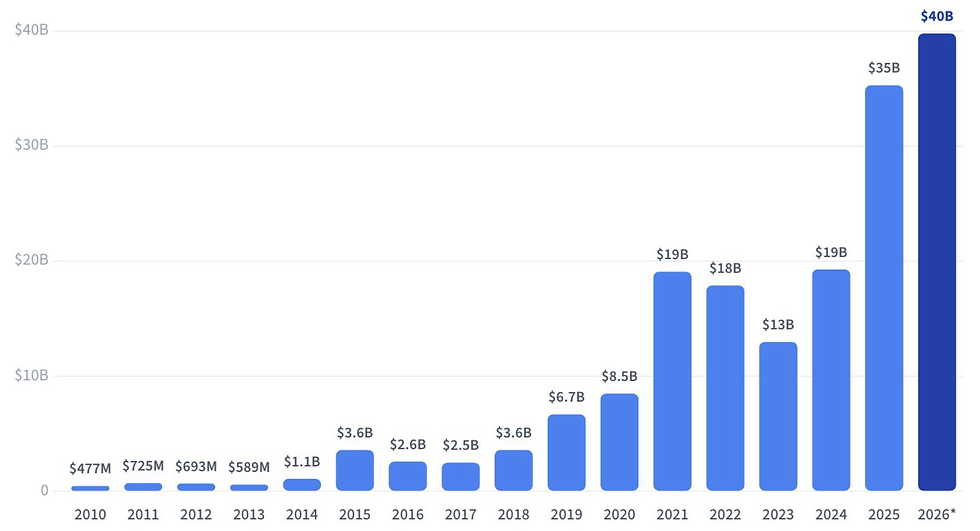
The broader implication is that defence tech is becoming a structural part of the venture landscape. The combination of geopolitical uncertainty, technological modernization, and growing demand for resilience is creating a larger and more durable pool of capital for companies operating in the sector. Unlike a short-lived funding spike, the consecutive annual increases suggest that defence and security are becoming established priorities within the current venture cycle.
Climate Tech
Climate tech presents a markedly different funding trajectory. The sector raised $19.5 billion in H1 2026, well below its 2021–2022 peak of approximately $75–76 billion. Investment has declined progressively from $52.1 billion in 2023 to $40.8 billion in 2024 and $39 billion in 2025, before reaching the current 2026 level. The data therefore shows a clear normalization from the exceptional funding levels seen earlier in the decade.
Unlike defence tech, climate tech has not benefited from the same acceleration in capital allocation. The current environment is particularly challenging because venture investors are increasingly concentrating capital around AI, deep tech, and other technologies capable of supporting very large financing rounds. As a result, climate-focused companies are competing for capital in a market where investor priorities have shifted significantly compared with the 2020–2022 period.
Climate Tech VC Investment

At the same time, the latest figures suggest that climate tech may be stabilizing rather than entering another sharp phase of decline. The sector's funding level has settled at a considerably lower level than its previous peak, but it remains a significant area of venture activity. This points to a market that may have reached a new, lower equilibrium: climate tech is no longer experiencing the extraordinary capital inflows of the earlier cycle, but neither has it disappeared from the venture landscape.
VI. Assessment
The first half of 2026 marks a clear structural shift in the global venture capital market, with artificial intelligence emerging as the dominant driver of both capital allocation and market dynamics. AI startups attracted $398 billion in H1 2026, accounting for roughly 77% of global venture investment. This level of concentration suggests that AI is no longer simply one of several major investment themes; it has become the central force shaping the overall venture landscape. The emergence of exceptionally large financing rounds, particularly around foundational AI models, has also changed the scale at which venture capital is being deployed. As a result, traditional measures such as the average venture round increasingly provide an incomplete picture of a market characterized by a small number of extremely large transactions alongside a much broader base of smaller deals.
However, the H1 2026 picture is not simply one of capital concentration around a handful of AI companies. The underlying market remains broader and more dynamic than the headline AI numbers might suggest. Even excluding OpenAI, Anthropic, and xAI, venture investment continues to expand, indicating that the recovery is not entirely dependent on the largest frontier-model companies. At the same time, the emergence of $2 billion-plus mega-rounds points to a lasting change in the structure of venture financing: transactions of this scale are becoming an increasingly established feature of the market rather than isolated exceptions.
The geographic picture reinforces this broader dynamic. While the US remains overwhelmingly dominant in absolute funding, Germany has moved into fifth place globally and Sweden has entered the top 10, while a diverse group of emerging ecosystems is recording much faster year-on-year growth. This suggests that the venture market is becoming simultaneously more concentrated at the top and more geographically expansive underneath it. Capital is increasingly concentrated in the largest AI-driven opportunities, but venture activity is also spreading across a wider range of established, emerging, and frontier ecosystems.
The same pattern can be seen at the sector level. AI, deep tech, robotics, chips, autonomous systems, and other forms of physical AI are attracting significant amounts of capital, pointing toward an investment cycle that increasingly connects software intelligence with physical infrastructure and real-world applications. At the same time, defence, security, and resilience have reached record funding levels, while climate tech has stabilized at a considerably lower level than its 2021–2022 peak.
H1 2026 should therefore be understood as a period of simultaneous concentration and expansion. Capital is becoming highly concentrated around AI, frontier technology, and a small number of companies capable of absorbing exceptionally large rounds, while venture activity itself is expanding across geographies, sectors, and new technology categories. The defining characteristic of the current cycle is not simply that more capital is being invested, but that the scale, geography, and strategic priorities of venture capital are changing at the same time. This makes H1 2026 an important inflection point for understanding how the global venture market may evolve in the years ahead.
Source: Dealroom, “The Half-Time Report - H1 2026 Venture Update”, published 29 July 2026.



Comments