
VC Investment Report - UK 2026 H1
The first half of 2026 has been a period in which capital concentration significantly accelerated, AI-centered technological transformation gained a structural character, and global competitiveness was reaffirmed for the UK innovation and entrepreneurship ecosystem. In an environment where global investor appetite remained selective and capital distribution concentrated on a limited number of high-trust areas, the UK technology ecosystem maintained its leading position in Europe in terms of investment volume and the quality of scaling companies. Especially the leap observed in late-stage mega investment rounds once again demonstrates the country’s capacity to bring its startups to an operational and financial depth that can compete on a global scale.
In the first half of 2026, UK-based startups attracted a total of $17 billion in venture capital (VC) investment; this amount marks a 102% increase compared to the same period in 2025, constituting the strongest first-half performance recorded since 2022. This level is also approaching the all-time first-half record of $20.8 billion recorded at the 2022 peak. The growth in investment volume also continued compared to the second half of 2025 ($15.2 billion), showing that the ecosystem recorded growth for the second consecutive half-year. This momentum stems not only from large-scale rounds but also from the structural rise in the share of late-stage capital within total investments.
According to the first-half data, artificial intelligence has definitively become the main axis of growth for the UK technology ecosystem. AI-focused startups attracted $12.6 billion in investment during this period, accounting for 74% of total VC investments alone, and broke a new annual record in just six months. The fact that all of the investment rounds over four billion dollars in the first half of 2026 belonged to AI startups clearly demonstrates at which technological layer the capital is concentrated. In addition, investments in deep tech and life sciences nearly doubled their share across Europe, confirming that the ecosystem is strengthening not only in software but also in hardware and science-based innovation.
This evaluation addresses the developments in the UK entrepreneurship ecosystem in the first half of 2026 across the axes of investment outlook, funding stages, AI investments, deep tech & life sciences performance, and general ecosystem outputs. All quantitative data and tables used in the study are taken from the "UK Innovation Update – H1 2026" report published in collaboration with Dealroom and HSBC Innovation Banking. Evaluated in a general framework, the first half of 2026 has been a strong period for the UK, in which the innovation economy entered a phase of global consolidation and technological deepening.
1. General Outlook and Market Dynamics
1.1. Investment Volume and Macroeconomic Performance
H1 2026 has been a strong period in which capital concentration and structural growth gained momentum for the UK technology ecosystem. During this period, UK-based startups secured a total of $17 billion in venture capital (VC) investment, reaching the highest first-half performance recorded since 2022. When compared with the $8.4 billion investment volume obtained in the same period of 2025, a net increase of 102% (approximately $8.6 billion) is observed. This volumetric expansion demonstrates that in an environment where global macroeconomic uncertainties and cautious liquidity conditions persist, international investor appetite shows a strategic orientation towards UK assets that offer high growth potential and operational depth. The continuation of growth compared to the $15.2 billion volume recorded in the second half of 2025 shows that the ecosystem is on an upward trend for two consecutive half-years and is again approaching the all-time record of $20.8 billion at the 2022 peak.
VC Investments by Year

The UK’s $1.7 trillion innovation economy has grown 6.7 times in the last decade, demonstrating a stable capacity to create value on a global scale. The ecosystem has produced 18 new unicorns so far in 2026, bringing the total number of unicorns to 217.
1.2. Regional Leadership and Market Share Analysis
The UK has maintained and further strengthened its status as the hub country in the European innovation rankings as of the first half of 2026. 39% of the total venture capital investments in Europe were directed to the UK ecosystem; with this ratio, the country attracted more capital than even its closest three competitors (Germany, France, and Sweden) combined. In the relevant period, the $17 billion investment volume obtained by UK-based startups reached approximately 2.5 times that of the closest competitor Germany ($6.8 billion) and approximately 3.1 times that of France ($5.4 billion), certifying the ecosystem as a financial center.
In terms of growth performance, the UK is the country that captured the highest momentum among Europe’s ten largest ecosystems with a 102% annual increase. While Germany grew by 48%, France by 61%, Sweden by 55%, and the Netherlands by 62%; Spain (-4%) and Switzerland (-6%) experienced contractions on an annual basis. This picture shows that the UK maintains its volumetric superiority and growth rate leadership simultaneously. Finland and Belgium also achieved growth close to 100% in this period.
Top 10 Destinations in Europe in VC investment

The country’s level has reinforced its feature of being the most favorable incubation center in Europe for startups that have high scaling capacity and produce outputs at global standards, beyond being a local market. Especially in deep tech and life sciences, the UK alone attracted 41% of European funding, receiving more capital than Germany, France, Sweden, and Switzerland combined (with $10.3 billion); this rate has nearly doubled from the 23% level in the second half of 2025.
1.3. Sectors and Investment Concentration
When sectoral distribution is analyzed, it is seen that capital concentrated in specific vertical areas in the first half of 2026. Enterprise software is the largest technology sector of the ecosystem with an investment volume of $5.9 billion and 166 rounds. The health sector, on the other hand, reached a volume of $3.8 billion through 161 different rounds, becoming the second widest-based vertical of the ecosystem in terms of both size and number of rounds.
Leading Sectors in VC Investment

In contrast, the hosting and cloud infrastructure sector represents the most extreme example of capital concentration, reaching a volume of $2.1 billion with only 4 investment rounds; this indicates the presence of a small number of but very large-scale investments in processing power infrastructure required for training AI models. While transportation ($1.6 billion/27 rounds), robotics ($1.5 billion/32 rounds), and fintech ($1.4 billion/105 rounds) sectors also generated significant volumes; fintech’s relatively lower total volume despite its high number of rounds shows that investments in this area are more dispersed and early-stage weighted. The investment flow in energy ($1.2 billion/77 rounds) and semiconductors ($1.1 billion/24 rounds) also confirms that the ecosystem allocates strong capital not only to digital services but also to physical infrastructure and hardware technologies.
2. Investment Segmentation and Rounds
2.1. Late-Stage Mega Rounds and Stages
The UK innovation economy confirmed the maturation in its financial architecture by evolving into a clearly late-stage weighted structure in investment stages in the first half of 2026. Late-stage and mega rounds accounted for $11.5 billion of the total $17 billion investment, representing 68% of the total volume; this rate was at 42% a year ago. Rounds of $250 million and above alone reached a record level of $8.6 billion, making up 51% of the total investment.
VC Investments by Rounds

2.2. Detailed Breakdown by Stages
In the detailed analysis conducted on a stage basis, it is revealed more clearly how the capital distribution in the UK underwent a structural transformation in the period extending from Q2 2022 to Q2 2026. While late-stage and mega rounds ($100-250 million and over $250 million) constituted the main financial engine of the ecosystem with $11.5 billion, the breakout stage (Series B and Series C) contributed $3.8 billion, and the early stage (pre-seed, seed, and Series A) contributed only $1.7 billion. When the quarterly trend is analyzed, it is observed that early-stage investments have generally fluctuated within a flat band since mid-2022, without experiencing a significant jump in any single quarter; this shows that although the seed and Series A segment maintains its capital attractiveness, it is not the engine of growth volumetrically. In the breakout stage, after the high levels observed in the first quarters of 2022, some weakening was experienced in the 2023-2024 period, but as of Q2 2026, a recovery trend has also become evident in this segment.
This concentration of capital in the late stage indicates that investors are now focusing on companies with proven revenue models, commercial validation, and scaling potential; conversely, the funding process for startups at earlier and riskier stages has become both more selective and longer-term.
2.3. Comparative Structure with Europe and the US
The investment structure of the UK has shifted significantly towards the late stage compared to the rest of Europe. In the first half of 2026, 68% of UK VC investments consisted of late-stage rounds, while this rate was 59% in Europe as a whole and 50% in France; this is the highest late-stage concentration among Europe’s largest ecosystems. In contrast, this rate reached 91% in the US, showing that the UK still has a more balanced stage distribution compared to the other side of the Atlantic.
Comparison of Investment Rounds

2.4. Prominent Investment Rounds
UK startups completed a total of 837 investment rounds in the first half of 2026. All four rounds over $1 billion that took place in this period belonged to AI startups: Isomorphic Labs ($2.1 billion, Series B, AI in drug discovery), Nscale ($2.0 billion, Series C, AI hyperscaler infrastructure), Wayve ($1.2 billion, Series D, autonomous driving), and Ineffable Intelligence ($1.1 billion, seed round, post-LLM AI). These four rounds alone accounted for 38% of the total capital provided in the first half. Comparatively, a higher number of rounds (1,127) took place in the UK in the first half of 2025, but only 6 AI mega rounds (totaling $1.4 billion) were recorded; in the first half of 2026, 19 AI mega rounds took place, and the largest four alone reached $6.4 billion.
Other prominent rounds include Recursive ($650 million, seed, self-improving AI), ElevenLabs ($500 million, Series D, voice synthesis with AI), Cusp.ai ($400 million, late VC, molecular simulation, Cambridge), OQC ($350 million, Series C, quantum computers, Reading), and PhysicsX ($300 million, Series C, physics simulation with AI). In health and deep tech, CellCentric ($220 million, Series D, cancer treatment), Olix ($220 million, Series A, photonic AI chips), and Fractile ($220 million, Series B, AI semiconductors) draw attention.
Strong momentum is also observed in the Series A segment. In the first half of the year, a total of 105 Series A rounds were completed, 56 of which were in the second quarter; 19 of these were carried out by AI startups. It is seen that the Series A market extends beyond AI and spreads across a wide spectrum with 41 deep tech and life sciences rounds. Although semiconductor startups carried out only 3 rounds, Olix’s $220 million round was the largest Series A investment of the first half. Other prominent Series A rounds include RQBio (£86 million, antibody discovery), Immutrin (£65 million, cardiac antibody therapy), Cytospire (£61 million, cancer immunotherapy), and in the field of precision manufacturing, Isembard ($50 million) and Isometric ($40 million).
3. Developments in the Artificial Intelligence Sector
3.1. Record Level in AI Investments
AI startups, which have been increasing rapidly since 2025, reached an investment volume of $12.6 billion in the first 6 months, breaking a new annual record in just six months. This level corresponds to more than 4 times the volume of $2.8 billion in the first half of 2025 and nearly 4 times the previous all-time peak of $3.2 billion recorded in 2022. The main breakthrough in investments in the field of AI occurred in the second half of last year, and in the first half of this year, this figure increased more than twofold compared to the previous period.
A large proportion of VC investments in AI consist of investments of $100 million and above. A total of 297 AI rounds closed in the first half; the mega rounds, which constituted only 19 of these, alone created $10 billion, equivalent to 80% of total AI investments. Although this number is close to the 303 AI rounds in the first half of 2025, the fact that there were 13 more mega rounds shows that capital is increasingly concentrated in larger-scale rounds in the AI field. This trend indicates that investors prefer to invest higher amounts in AI companies with strong growth potential and proven business models rather than early-stage startups. At the same time, this concentration in investment volume reveals that capital in the AI ecosystem is increasingly clustered in specific companies and large-scale funding rounds.
VC Investments in AI (6 months)

3.2. Sectoral Distribution: The Leadership of Enterprise Software
When the sectoral distribution of AI investments is analyzed, it is seen that enterprise software is the clear leader in terms of both number of startups and total capital attraction. Since 2020, 1,868 AI startups have been established in the field of enterprise software, and these startups have attracted a total of $17.2 billion in investment. The healthcare sector ranks second by a wide margin with 669 AI startups and $8.5 billion in investment. Although fintech is at a level close to the health sector in terms of the number of startups, it lags behind in terms of the investment amount per company. In contrast, although the hosting sector has only 32 AI startups, it drew attention in terms of capital density by receiving $4.3 billion in investment across 4 major investments.
AI Investments by Sector

3.3. AI Impact on Deep Tech and Life Sciences
It is observed that VC investments in the UK have been increasingly shaped around the axis of AI in recent years. Deep tech and life science investments excluding AI have displayed a relatively stable outlook since 2022, hovering around $2–2.5 billion on a half-year basis. In contrast, AI investments outside deep tech and life sciences have gained a strong momentum especially from the second half of 2025 and reached approximately $4.8 billion in the first half of 2026. This situation indicates that investor interest is increasingly directed towards AI-focused startups.
The most remarkable development occurred in investments at the intersection of AI, deep tech, and life sciences. The investment volume in this field reached $7.9 billion in the first half of 2026, rising significantly above previous periods. While large-scale transactions such as Isomorphic Labs’ $2.1 billion investment round were decisive in this increase, it is seen that AI has become a primary investment theme in high value-added fields such as pharmaceuticals, biotechnology, and advanced scientific research. The analysis reveals that AI stands out not only as an independent technology area but also as a strategic element that accelerates the growth of deep tech and life sciences.
4. VC Investments in Deep Tech and Life Sciences
The UK increased its share of European deep tech and life sciences funding from 23% in the second half of 2025 to 41% in the first half of 2026, nearly doubling it. Behind this increase lies the $3.4 billion leadership in biotechnology, autonomous technology investments leaping from almost zero to $1.4 billion, and a $0.7 billion contribution in the AI media field led by companies like ElevenLabs and Synthesia. This volume, reaching $10.3 billion in total, is even more than the total deep tech & life sciences investments of Germany, France, Sweden, and Switzerland combined.
This performance demonstrates that the UK has risen to become the clear leader in Europe in capital-intensive fields requiring scientific depth such as biotechnology, autonomous systems, and advanced materials science, in addition to software and digital services. The depth of the country’s research infrastructure and academic-commercial cooperation models stand out as key elements supporting the sustainability of capital attraction capacity in this field.
VC Investment to Deep Tech and Life Sciences in Europe

This performance demonstrates that the UK has risen to become the clear leader in Europe not only in software and digital services, but also in capital-intensive and scientifically profound fields such as biotechnology, autonomous systems, and advanced materials science. The depth of the country's research infrastructure and its academic-commercial collaboration models stand out as key elements supporting the sustainability of its capital attraction in this area.
5. Ecosystem Performance
5.1. Size of the Innovation Economy
The UK innovation economy strengthened its competitive position on a global scale with a total enterprise value of $1.7 trillion reached as of the first half of 2026. This value has grown 6.7 times in the last decade, showing that the ecosystem exhibits a stable compound growth performance. The fact that 49% of the ecosystem value consists of companies established after 2010 indicates that the UK’s capacity to produce next-generation startups forms a balanced combination with the value created by older-generation technology companies.
UK Innovation Economy by Establishment Year (Cumulative Value)

5.2. Efficiency on a Scale Basis
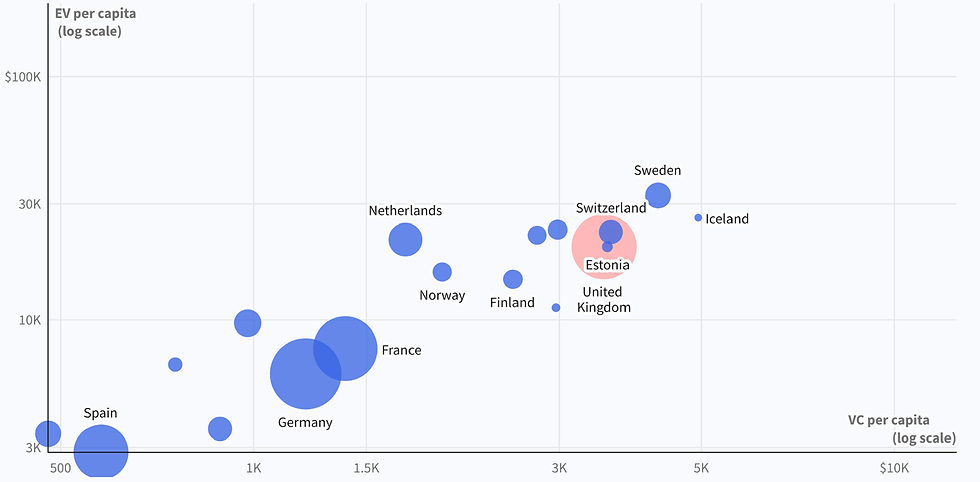
The UK’s ecosystem value also performs significantly above Europe’s leading economies in terms of value per capita. On the scale of enterprise value per capita, the UK produces approximately 3-4 times more value than France and Germany. This shows that the country is in an exceptional position across Europe not only in terms of absolute size but also in terms of capital and population efficiency; after smaller-scale but high-density ecosystems such as Sweden and Switzerland, the UK is the country that produces the highest per capita value among large-scale economies.
Ecosystem Value by Country
5.3. Regional Distribution and Growth
London maintains its feature of being by far the UK’s largest innovation hub with an enterprise value of $947 billion; this is followed by the East of England with $511 billion. However, when the five-year growth performance is analyzed, the picture changes significantly: Leicestershire is the fastest-growing region in the UK with 5.0x growth; it is followed by Berkshire with 4.3x and the East of England with 3.9x, largely driven by ARM reaching a valuation of $417 billion. This table shows that the UK’s innovation economy is spreading beyond London and entering a process of regional diversification.
Leading Regions

When the sectoral sources of regional growth are analyzed, it is seen that different regions specialize in different industries. 93% of the growth in the East of England stems solely from the semiconductor sector led by ARM; while in the Midlands, 69% of growth comes from the enterprise software sector (as in the example of Access), 40% in Yorkshire and the Humber, and 35% in North West England again comes from enterprise software. In contrast, London exhibits balanced growth in almost every sector such as fintech (42%, primarily the Revolut example), health (15%), energy (12%), and enterprise software (12%), proving that it has a diversified structure that is not dependent on a single sector.
Geographically, the majority of investments outside London were directed to regional hubs focused on deep tech and AI such as Cambridge ($941 million), Reading ($379 million), Oxford ($240 million), and Edinburgh ($160 million). In these hubs, significant rounds took place in science-based fields such as molecular simulation (Cusp.ai, $400 million, Cambridge), quantum computers (OQC, $350 million, Reading), and agricultural technology (Tropic, $105 million).
VC Investment by Region and Leading Rounds

5.4. Structure and Outputs of the UK Entrepreneurship Ecosystem
The UK entrepreneurship ecosystem is one of the most mature startup ecosystems in Europe, not only due to its high investment volume but also because of its strong structure that enables startups to progress sustainably through different growth stages. When the startup funnel is analyzed, it is seen that approximately 1,600 startups complete their first VC investment round each year, accounting for approximately 24% of the total in Europe. Currently, 13,300 VC-backed startups operate in the country, corresponding to 28% of VC-backed companies in Europe. Approximately 2,000 of these startups have reached the breakout stage, and 455 have reached the scale-up stage. The rise in the share within the European total to 34% and 38% respectively shows that the UK performs strongly both in its capacity to generate new startups and in scaling these startups to transform them into companies that can compete globally.
The output indicators of the ecosystem also support this maturation. According to the data, 632 companies reached the annual revenue band of $25–100 million, while 217 companies succeeded in reaching unicorn status or making an exit of over $1 billion, and 262 companies rose to the category of companies generating over $100 million in annual revenue. The fact that the share of companies reaching the upper steps of the startup pyramid within total VC-backed startups is around 10% reveals that the UK ecosystem does not only produce a high number of startups but can also transform a significant portion of these startups into companies that create value globally. In addition, the fact that companies such as Huel, 9fin, PhysicsX, Granola, Allica Bank, Ineffable Intelligence, Cusp.ai, Recursive, and BVNK reached unicorn status in the first half of 2026 shows that the ecosystem continues to produce next-generation high-valuation technology companies.
One of the most important structural advantages of the UK entrepreneurship ecosystem is the self-reinforcing entrepreneurship mechanism, expressed as the "founder loop" in literature. Founders and employees leaving successful technology companies to establish new startups ensures that knowledge, capital, and entrepreneurship culture are constantly recirculated within the ecosystem. In this context, 54 unicorn companies of UK origin have contributed to the establishment of 464 new tech startups across Europe, creating the region’s strongest ecosystem for training entrepreneurs. The fact that successful startups do not only produce economic value but also create a human capital pool that enables new startups to emerge creates a significant competitive advantage for the long-term sustainability of the ecosystem.
Company-specific examples also reveal the concrete results of this loop. 57 new startups, including successful companies such as Gorillas and Zego, were established by entrepreneurs leaving Deliveroo, while startups founded by GoCardless alumni, such as Monzo, incident.io, Nested, and Duffel, attracted a total of over $2.18 billion in investment. This indicates that successful technology companies are not limited to their own growth but function as founder factories leading to the birth of new startups. Thus, entrepreneurial experience, management capability, and investor networks are reproduced within the ecosystem, ensuring the continuity of innovation capacity.
Geographically, this entrepreneurship loop is predominantly centered in London. London is by far the country’s strongest entrepreneurship center with 43 unicorn founder factories and 388 tech startup spin-offs. Nonetheless, regional innovation hubs such as Cambridge, Bristol, Edinburgh, York, Manchester, and Warrington also strengthen the geographical diversity of the ecosystem by training unicorn founders and contributing to the formation of technology-oriented startups. In particular, Cambridge’s deep tech and university-based entrepreneurship capacity, along with Edinburgh’s success in producing research-focused technology companies, demonstrate that the UK innovation ecosystem is not only London-centric but has gained a multi-centered structure spreading across the country.
The first half of 2026 has been a period in which not only the increase in investment volume but also the structural maturity of the ecosystem became evident for the UK entrepreneurship ecosystem. When the strong funding infrastructure supporting the growth journey of startups from early stage to unicorn level, the entrepreneurship loop fed by new startups born from successful companies, and the innovation hubs spreading across the country are evaluated together, it is observed that the UK maintains its position as Europe’s most advanced technology ecosystem. This structure further solidifies the UK’s leading position in the international technology ecosystem by increasing its global competitiveness, especially in high value-added sectors such as AI, deep tech, and life sciences.



Comments