
VC INVESTMENT REPORT - UK 2026 Q3
The third quarter of 2026 was a period in which the United Kingdom innovation and entrepreneurship ecosystem demonstrated a clear divergence between capital deployed into companies and capital raised by investors themselves. While the amount invested in startups moderated from the exceptional levels of the previous quarter, the amount raised by United Kingdom venture capital managers reached the highest level ever recorded in a single quarter. In an environment where global investor appetite remains selective and capital is concentrated in a limited number of high-conviction areas, the United Kingdom technology ecosystem has maintained its leading position in Europe in terms of the number of rounds, the depth of its investor base and the quality of the companies that are scaling.
In the third quarter of 2026, startups headquartered in the United Kingdom attracted a total of $6.1 billion in venture capital (VC) investment across 367 rounds. This amount represents the second strongest third quarter of the past five years, behind only the $9.3 billion recorded in the third quarter of 2025, and corresponds to a 34% decline compared with the same period of the previous year. The decline, however, should be read together with the fact that late-stage rounds continued to account for the majority of capital, that breakout-stage investment increased its share of the total, and that Series A investment grew by 40% in value year on year. In other words, the quarterly decrease reflects the absence of very large rounds comparable to those of a year ago rather than a weakening of the underlying pipeline.
The most striking development of the quarter, however, came from the investor side. United Kingdom venture managers closed 31 new funds worth $6.9 billion, which is the highest quarterly fundraising total on record and approximately four times the quarterly average of the past two years. At the same time, semiconductor startups surpassed the sector’s previous full-year investment record with a quarter still to run, and the regional investor base broadened considerably, with funds headquartered outside London driving most of the increase in deal activity among the quarter’s leading investors.
This assessment examines the developments in the United Kingdom entrepreneurship ecosystem in the third quarter of 2026 along the axes of investment outlook, funding stages, largest rounds, sectoral distribution, semiconductor performance, venture fundraising and investor activity, and overall ecosystem output. All quantitative data and tables used in this study have been taken from the “UK Innovation Update - Q3 2026” report published by Dealroom.co in collaboration with HSBC Innovation Banking. Taken as a whole, the third quarter of 2026 was a period in which the United Kingdom innovation economy built a deeper and more diversified capital base for the years ahead, even as the volume of capital deployed in the quarter itself was lower than a year earlier.
1. General Outlook and Market Dynamics
In the third quarter of 2026, startups headquartered in the United Kingdom raised a total of $6.1 billion in venture capital, which makes this the second strongest third quarter in five years. Compared with the $9.3 billion raised in the third quarter of 2025, this corresponds to a decrease of approximately 34%. When the quarter is viewed against the immediately preceding quarter, in which the ecosystem attracted approximately $9.5 billion, the third quarter also represents a moderation from the exceptional pace set in the first half of the year. Nevertheless, the cumulative investment volume of the first nine months of 2026 reached $23.3 billion, an increase of 18% compared with the same period of 2025, which confirms that the broader trend remains one of growth.
UK VC Investment by Stage - Quarterly

The composition of the quarter is as important as its total. Late-stage rounds of $100 million or more raised $3.5 billion across 11 deals and accounted for 58% of all United Kingdom venture capital in the quarter. CityFibre’s $1.2 billion growth equity round, which was completed in July 2026, was the largest round of the quarter and the fourth-largest United Kingdom round of the year so far, ahead of FNZ’s $450 million and Open Cosmos’s $346 million rounds. This shows that, in an environment of cautious liquidity conditions and persistent global uncertainty, international and domestic investors continue to direct strategic capital towards United Kingdom assets that offer high growth potential and operational depth.
The United Kingdom has preserved its position as the leading country in the European innovation hierarchy in the third quarter of 2026. The country raised 25% of all European venture capital in the quarter and closed 367 rounds, which corresponds to 30% of every round raised in Europe. The number of rounds completed in the United Kingdom was higher than the combined number of rounds in Germany (138), France (100) and Sweden (76), which shows the unmatched breadth of the ecosystem. In terms of capital volume, the United Kingdom’s $6.1 billion was followed by Germany with $5.0 billion, France with $4.6 billion, Sweden with $1.8 billion and Finland with $1.4 billion, so the gap in invested capital was narrower than the gap in deal activity.
Top 10 European Countries by VC Investment (Q3, 2026)

In terms of growth performance, the picture of the quarter is more mixed. The United Kingdom’s venture capital volume declined by 34% compared with the third quarter of 2025, whereas Germany grew by 267%, Sweden by 338% and Portugal by 701%, albeit from lower bases. France increased by 50%, the Netherlands by 53%, Italy by 128%, Switzerland by 26% and Spain by 8%, while Finland recorded a decline of 4%. This indicates that the quarterly year-on-year comparison is influenced heavily by the exceptionally large rounds that were recorded in the United Kingdom a year ago and by large individual transactions in other European markets.
When the first nine months of 2026 are considered, the United Kingdom’s leadership becomes much clearer. The country raised $23.3 billion across 1,219 rounds and took 35% of all European venture capital, ahead of Germany ($10.4 billion, 432 rounds), France ($10.0 billion, 371 rounds), Sweden ($4.6 billion, 225 rounds) and the Netherlands ($3.3 billion, 235 rounds). The United Kingdom’s 18% year-on-year growth over this period is lower than that of Germany (74%), France (56%), Sweden (106%) and the Netherlands (51%), but the absolute volume advantage of the United Kingdom has been maintained.
2. Investment Segmentation and Rounds
In the third quarter of 2026, the capital distribution of the United Kingdom innovation economy continued to be shaped by late-stage mega rounds. Late-stage rounds of $100 million or more raised a total of $3.5 billion, followed by $1.9 billion at the breakout stage and $740 million at the early stage. This means that late-stage investment represented approximately 58% of all capital raised, breakout-stage investment approximately 30% and early-stage investment the remaining share of the quarter’s total. The concentration of capital in a small number of large rounds shows that investors continue to focus on companies with proven revenue models, commercial validation and scaling potential.
It is also noteworthy that the breakout stage, which covers Series B and Series C rounds between $15 million and $100 million, increased its share of the quarter’s capital from 24% a year ago to 30%. The $1.9 billion raised across 55 deals at this stage suggests that the middle of the funding ladder is strengthening, and that companies that have passed the early-stage threshold are finding capital to continue their growth. Early-stage investment, which includes pre-seed, seed and Series A rounds, remains in a relatively narrow range and continues to attract capital, although it is not the main driver of volume growth.
The twelve largest rounds of the quarter show the sectoral breadth of capital deployment. CityFibre (Fibre Broadband, London) led the list with $1.2 billion in July 2026, followed by FNZ (Wealth Management, London) with a $450 million growth equity round in September 2026 and Open Cosmos (Earth Observation, Harwell) with a $346 million late-stage venture capital round in September 2026. The fourth-largest round was OLIX’s $312 million Series B in August 2026 for photonic artificial intelligence chips, followed by Cambridge Aerospace’s $300 million Series C in August 2026 in air and missile defence, Volta’s $225 million Series A in August 2026 in artificial intelligence data centres, Kraken’s $175 million Series B in July 2026 in maritime defence and Humanoid’s $152 million Series A in July 2026 in humanoid robots.
The list was completed by Basecamp Research’s $140 million Series C in September 2026 for protein discovery, Nexeon’s $132 million late-stage venture capital round in August 2026 for silicon battery anodes, Callosum’s $100 million seed round in August 2026 for artificial intelligence orchestration and Dwelly’s $95 million Series B in July 2026 for artificial intelligence lettings. Nine of the twelve largest rounds were raised by London-based companies, with Open Cosmos in Harwell, Cambridge Aerospace in Cambridge and Abingdon-based Nexeon being the exceptions. The presence of defence, space, semiconductor, robotics and energy storage companies in this list also confirms that the capital flow is moving towards deep technology and strategic sectors in addition to software.
Series A investment recorded a strong performance in the third quarter. United Kingdom startups raised $1 billion across 35 Series A rounds, which represents a 40% increase in value compared with the third quarter of 2025. Volta led the segment with a $225 million round in August 2026, the largest Series A round of the year so far, and was one of only two Series A rounds that exceeded $100 million, alongside Humanoid’s $152 million round in July 2026.
Beyond these two rounds, the segment was distributed across a wide range of sectors. Valarian (data sovereignty, London) raised $50 million, Greenjets (electric propulsion, Bedford) and Jack & Jill (artificial intelligence recruitment, London) each raised $40 million, Velocity (digital assets, London) raised $38 million, Alchemab Therapeutics (drug discovery, London) raised $33 million, Arboreal (innovative food, Birmingham) raised $31 million and Arrakis Technologies (industrial artificial intelligence, London) raised $30 million. This diversity indicates that the Series A segment continues to be a healthy entry point for companies in artificial intelligence infrastructure, robotics, life sciences, energy and financial technology, and that it is not dependent on a single theme.
3. Sectoral Overview of Investments
When the sectoral distribution of the third quarter is examined, capital is observed to be concentrated in a few large transactions, while deal activity is distributed more broadly. The telecommunications sector led all industries with $1.20 billion of investment, but this was achieved through only five rounds and was carried almost entirely by CityFibre’s $1.19 billion round. Financial technology followed with $791 million across 51 rounds, driven largely by FNZ’s $450 million round. Security attracted $778 million across 28 rounds, and health attracted $645 million across 62 rounds, led by Basecamp Research’s $140 million Series C. Semiconductors raised $497 million across 18 rounds, driven by OLIX’s $312 million Series B, followed by energy with $428 million across 43 rounds, robotics with $411 million across 15 rounds, space with $351 million across only two rounds, transportation with $264 million across 11 rounds and hosting with $231 million across three rounds.
UK Leading Industries by VC Investment in Q3 2026

In terms of deal count, health led the ecosystem with 62 rounds, followed by financial technology with 51 rounds and energy with 43 rounds. The contrast between telecommunications, space and hosting, which attract large amounts of capital with very few rounds, and health, financial technology and energy, which attract smaller but more numerous investments, shows that the ecosystem combines capital-intensive infrastructure investment with a broad base of early and growth-stage company building. It should be noted that the sector segments used in this analysis overlap with each other, so a single company can be counted in more than one segment.
The third quarter of 2026 saw the largest-ever United Kingdom semiconductor seed and Series B rounds. United Kingdom semiconductor startups have raised $1.59 billion so far in 2026, which is already an all-time annual record with a quarter still to run. Almost half of all United Kingdom semiconductor funding since 2010 has now been raised in the past two years, which demonstrates the growing momentum behind the sector.
OLIX set the Series A record in the first quarter of 2026 with a $220 million round and the Series B record in the third quarter with a $312 million round, raising a total of $532 million within nine months. Callosum’s $100 million round in August 2026 is the largest seed round ever raised by a United Kingdom semiconductor company. For comparison, the largest Series C round remains Quantinuum’s $600 million round from September 2025, the largest Series D round is Pragmatic’s $214 million round from December 2023 and the largest Series E round is Graphcore’s $222 million round from December 2020. This progression shows that the United Kingdom semiconductor sector is now producing record-setting rounds at earlier stages than in the past, which is a sign of a maturing and increasingly well-funded ecosystem.
4. Venture Capital Fundraising and Investor Activity
One of the most significant developments of the third quarter was the record level of capital raised by United Kingdom venture managers. In the third quarter of 2026, United Kingdom venture managers closed 31 new funds worth $6.9 billion, which is four times the quarterly average of the past two years and the highest quarter on record. The previous peak levels in the series were $6.0 billion in the third quarter of 2021 and $5.0 billion in the first quarter of 2022. The new funds were raised across seed, venture and growth strategies, which indicates that the fundraising was not limited to a single stage of the company lifecycle.
New VC funds in the UK by quarter
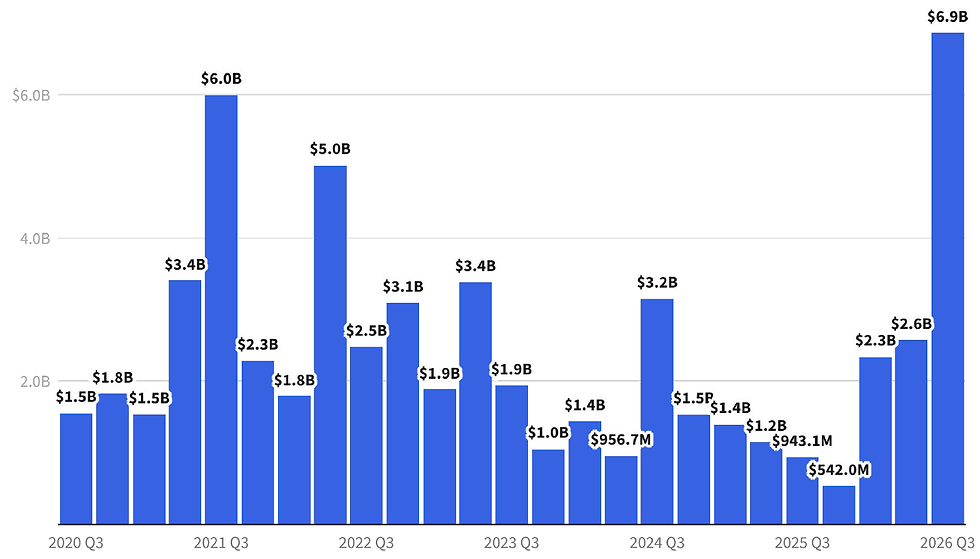
This fundraising total is also significant when it is placed next to the $6.1 billion invested in United Kingdom startups and scaleups during the same quarter. The fact that the amount raised by managers exceeded the amount invested in companies points to a large pool of capital that is available for deployment in the coming years, both in the United Kingdom and around the world. Industry commentators have also noted that the United Kingdom is on track for an all-time high in venture capital dry powder in 2026, and that the central challenge now is to ensure that this depth of capital translates into a stronger pipeline of companies able to build and scale from the United Kingdom.
The record fundraising quarter was largely driven by a small number of major fund closes. Index Ventures accounted for just over half of the capital raised by United Kingdom venture funds in the quarter, closing three funds worth $3.5 billion across seed, venture and growth strategies: the Index Ventures Growth Fund ($2.2 billion), the Index Ventures Venture Fund ($900 million) and the Index Ventures Seed Fund ($400 million), all closed in July 2026. Highland Europe’s sixth growth fund, with €1.1 billion, and QuantumLight’s second fund, with $500 million, were the other largest closes, while White Star Capital’s fourth fund raised $250 million and Crane Venture Partners raised $484 million across four funds.
Largest New UK VC Funds (Q3 2026)

Although this concentration at the top is striking, the range of fund strategies is equally important, because companies require different kinds of backing as they mature. A healthy venture market combines specialist early-stage investors, experienced growth managers and firms able to support international expansion, and the third quarter fundraising results contain examples of each of these categories.
The Most Active Investors and Regional Funds
The list of the most active investors in the United Kingdom in the third quarter of 2026 shows that the deal counts of the leading investors nearly tripled compared with the same quarter of the previous year, with regional funds driving most of the increase. SFC Capital led the ranking with 13 disclosed rounds, five of which it led, rising from only three United Kingdom rounds in the third quarter of 2025. Mercia Ventures and PXN Ventures each participated in eight rounds, followed by the Business Growth Fund, Northstar Ventures and Scottish Enterprise Growth Investments with six rounds each, The FSE Group with five rounds, and Beringea, Fuel Ventures and Future Planet Capital with four rounds each.
Top 10 VC Investors in the UK (Q3 2026)

Nine of the quarter’s ten leading investors were also active a year ago, and nine of the ten are based in the United Kingdom, with half of them headquartered outside London. Northstar Ventures in Newcastle and Scottish Enterprise in Glasgow each went from one United Kingdom round a year ago to six rounds this quarter. This development shows that the regional investor base is deepening and that early-stage capital is increasingly available beyond the established centres.
5. Ecosystem Performance
The United Kingdom innovation economy has reached a combined enterprise value of $1.7 trillion, and this value has grown 6.4 times over the past decade. Companies founded since 2010 now account for 49% of the innovation economy’s total enterprise value, which indicates that the ecosystem is balancing the value created by older generations of technology companies with the value created by newer ones. This performance supports the view that the United Kingdom has sustained a compounding growth pattern over a long period and that the third quarter’s lower investment volume has not altered the structural trajectory of the ecosystem.
Size of The Innovation Economy

The regional distribution of venture capital in the third quarter shows that investment continues to reach innovation hubs across the United Kingdom. Scottish startups raised $103 million across 21 rounds, led by Mironid’s $46 million Series B in Glasgow. Investment is also reaching hubs beyond the established centres, including Draig Therapeutics’ $65 million Series B in Cardiff and Advanced Electric Machines’ $21 million Series B round in Sunderland.
VC per Capita by UK region (Q3 2026)

Measured by venture capital per capita, London remains far ahead with $484, followed by the East of England with $82 and the South East with $66. Wales attracted $21 of venture capital per capita, the same level as the South West and ahead of both Scotland ($19) and the Midlands. These figures show that, although capital remains heavily concentrated in London and the surrounding regions, investment is gradually spreading to a wider range of regional hubs, supported by the growing activity of regional investors described in the previous section.
6. Conclusion
The third quarter of 2026 was a period in which the United Kingdom venture capital ecosystem showed both the strength and the challenges of its current position. The $6.1 billion invested in startups was lower than the exceptional level of a year ago, yet it remained the second strongest third quarter of the past five years, and the share of breakout-stage and Series A investment increased. The record $6.9 billion raised by United Kingdom venture managers across 31 new funds, the record-setting semiconductor rounds, the growing activity of regional investors and the continued leadership of the United Kingdom in the number of European rounds together confirm that the depth of capital and entrepreneurial talent in the country remains considerable.
At the same time, the quarter highlights the importance of converting this depth of capital into a stronger pipeline of companies that can scale and remain anchored in the United Kingdom. The concentration of capital in a small number of very large rounds and fund closes, together with the year-on-year decline in quarterly investment volume, suggests that maintaining the country’s leading position will depend on creating the conditions in which ambitious businesses can grow over the long term. Considered as a whole, the third quarter of 2026 has strengthened the foundations of the United Kingdom innovation economy for the years ahead.



Comments